


Why Your Hotel Blog Isn’t Working
For years, the hospitality industry has operated under a simple assumption: every hotel should have a blog. Publish more content, rank for more keywords, attract more traffic, and bookings will follow.
So a blog section appears in the navigation. A few destination guides are written. Perhaps a “Top 10 Things to Do.” Maybe an event announcement or two. The intention is sound. The outcome is usually underwhelming.
Traffic may increase marginally. Bookings rarely do. Within a year, the blog becomes a quiet archive rather than a performance driver.
The issue is not that blogging is outdated. A hotel blog can drive bookings. We have seen it work repeatedly. The issue is that most hotel blogs are written without commercial intent, competitive awareness, or strategic supervision.
Before deciding whether to publish more, it is worth clarifying what a hotel blog is actually meant to do.
Why Most Hotel Blogs Don’t Work
Most hotel blogs fail for predictable reasons. They are written as marketing exercises rather than demand interception tools. Topics are chosen because they “sound useful” rather than because they align with real booking behaviour. The result is content that exists, but does not perform.
The most common pattern is generic destination content. “Top 10 Things to Do.” “Why Visit [City].” “Hidden Gems in [Region].” These posts compete directly with tourism boards, travel publishers, and high-authority media sites that have far stronger brand awareness, history and content depth. A single hotel rarely wins that battle.
Increasingly, there is another layer. Content is produced quickly using AI tools, lightly edited, and published at volume. Structurally, it looks correct. It has headings, internal links, images, even keywords. But it lacks competitive awareness, local nuance, and commercial alignment. It could belong to almost any hotel in the region.
Search engines and AI systems do not reward interchangeable content indefinitely. If a page does not offer clearer intent alignment or deeper specificity than what already exists, it becomes invisible over time.
There is also a structural misunderstanding at play. Many hotels treat blogging as an SEO volume strategy. Publish more pages. Rank for more phrases. Increase traffic. But hospitality demand is not evenly distributed across thousands of informational queries. Bookings tend to cluster around specific decision-stage searches tied to events, amenities, location advantages, or seasonal behaviour.
When a blog is written without mapping those demand clusters, it becomes an archive rather than an asset. This distinction is particularly important for hotels where non-brand demand must offset OTA dependency. If informational visibility does not eventually support direct booking behaviour, it does not change distribution economics. Traffic alone does not reduce commission exposure.
What a Hotel Blog Actually Is
The term “blog” is increasingly misleading.
For many hotels, it suggests a diary, a news feed, or a marketing obligation. In practice, a blog is simply a flexible publishing layer within the website architecture. It allows a hotel to create pages that do not naturally fit into the traditional fixed hierarchy of homepage, rooms, amenities, offers, services etc.
Certain content does not belong on a room page. Other content does not justify a permanent navigation item. Seasonal demand, event-driven searches, amenity-specific questions, and location-based comparisons often require their own focused pages. A blog structure provides the freedom to publish these without distorting the core site architecture.
In this sense, a blog is not a content strategy in itself. It is a container. What determines performance is not the existence of the container, but the intent and structure of what is placed inside it.
When aligned with real booking behaviour, blog content can intercept decision-stage searches and guide users directly into the booking journey. When misaligned, it becomes a collection of loosely related articles that expand the site without strengthening it. Understanding this distinction is the first step toward making a hotel blog work.
When a Hotel Blog Drives Bookings
A hotel blog drives bookings when it aligns with how people actually search when they are close to making a decision.
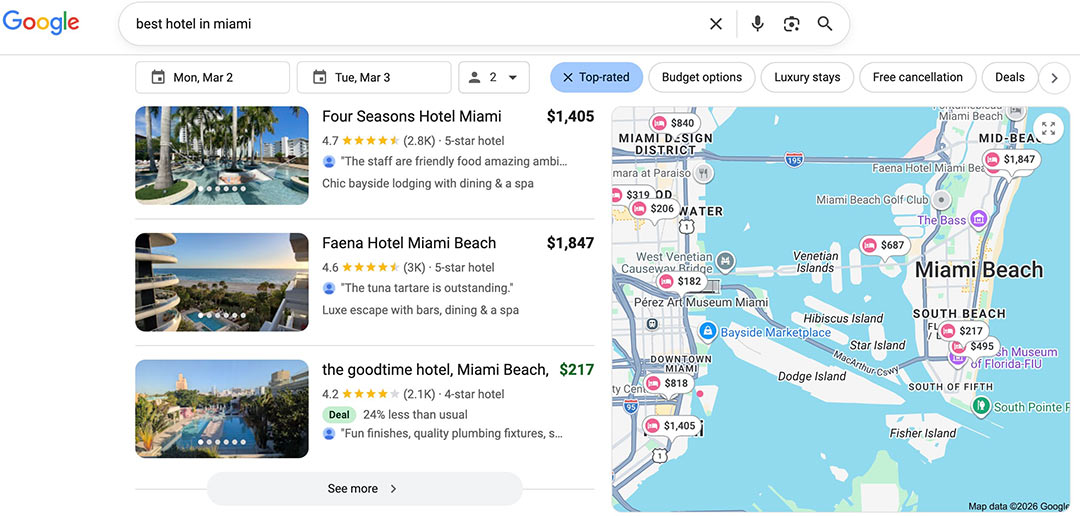
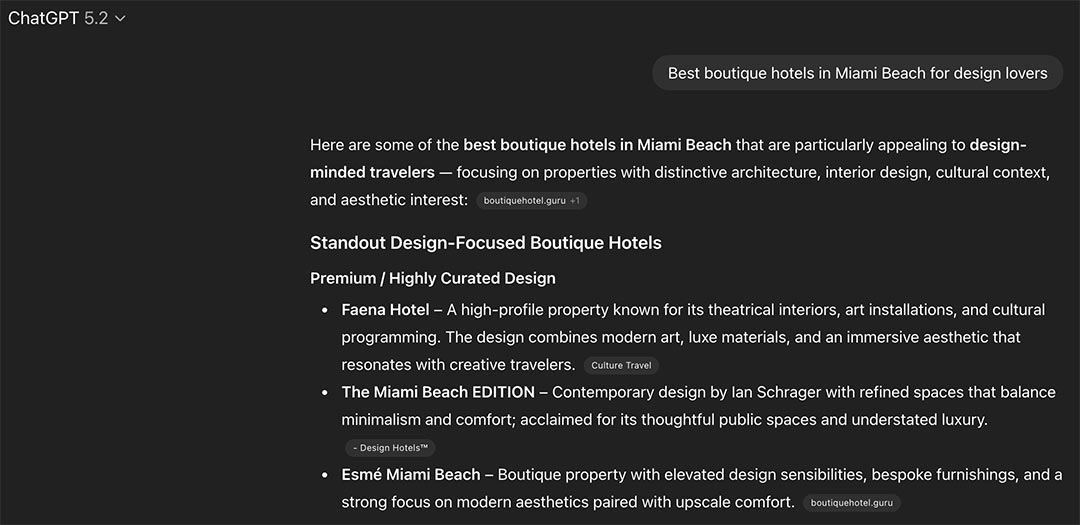
Most travel research begins broadly. It narrows quickly. By the time someone is comparing options, their queries become specific and situational. They are no longer searching for “things to do in Miami”. They are searching for where to stay for a particular reason. This shift toward specific and situational queries is most visible in AI chats, where users ask for hotel recommendations aligned with defined needs and preferences.
This is where a blog can become commercially powerful.
Consider event-driven demand. Large concerts, conferences, sporting fixtures, trade fairs, university graduations, seasonal festivals. These create temporary spikes in highly specific search behaviour. Users look for hotels near a venue, within walking distance of a stadium, or close to an exhibition centre. A well-structured page addressing that exact scenario can intercept real booking intent.
The same applies to amenity-led searches. Pet-friendly stays. On-site parking in city centres. Family rooms near a theme park. Accessibility features. These are not inspiration queries. They are filters. When a blog page addresses them directly, with clarity and specificity, it can convert.
Location nuance also matters. “Best area to stay in [destination]” is often not a tourism question. It is a decision question. A hotel positioned confidently within that discussion, explaining why its location suits certain types of travellers, can guide users from uncertainty to action. In each of these cases, the blog is not generating abstract traffic. It is intercepting users who are already narrowing options. That distinction is critical.
This is why some hotel blog posts produce measurable booking activity while others generate impressions but few clicks and no revenue. The difference is intent alignment.
When a Blog Isn’t Necessary
Not every hotel needs an active blog.
Properties with strong brand demand, consistent PR coverage, or a high repeat guest base may already generate the majority of their bookings through brand searches and direct reputation. In those cases, visibility is driven externally through media exposure, awards, partnerships, and word-of-mouth rather than informational search.
For a well-positioned luxury property with sustained press attention, a structured news section may be sufficient. Press releases, coverage highlights, and event announcements reinforce authority without requiring a steady stream of destination content. The publishing layer still exists, but its purpose is brand reinforcement rather than demand capture.
Some highly curated properties take a different approach. Rather than targeting search demand, they use blog content as an editorial extension of the brand. In these cases, the objective is not incremental visibility but identity reinforcement. Success is measured less in traffic growth and more in coherence, positioning, and guest expectation.
Similarly, hotels in supply-constrained destinations or with limited competition for non-brand terms may not benefit meaningfully from ongoing blog production. If generic search demand does not materially influence booking flow, adding more informational pages will not change performance.
Blogging becomes more commercially measurable when non-brand demand matters. When users are actively comparing areas, amenities, or stylistic positioning, content can help shape their decisions. Where brand strength already dominates the funnel, the incremental return in direct demand capture may be limited, but reinforcing brand position can be hugely valuable.
Recognising this distinction is part of strategic discipline. Publishing for the sake of it rarely improves outcomes.
AI Visibility Is Real – But Conditional
Search is no longer limited to ten blue links.
Traditional results increasingly include AI-generated summaries and overviews. Google’s AI Overviews and AI Mode are reshaping how information is presented within the search interface itself. At the same time, conversational systems such as ChatGPT have become common starting points for travel research. This shift has practical implications for hotel content.
Well-aligned blog pages that clearly address specific, situational queries can surface quickly within these environments. We have observed cases where newly published, intent-focused content is indexed and referenced in AI-assisted responses within days. The common thread is not volume or keyword stuffing, but clarity of alignment with active demand. However, this visibility is conditional.
Generic destination content rarely appears. Interchangeable “Top 10” lists do not offer enough distinction to be selected or summarised. AI systems, like traditional search engines, rely on patterns of relevance, specificity, and topical reinforcement. Pages that demonstrate clear intent alignment and contextual authority are more likely to be referenced. Pages that blend into the background are not.
It is also important not to overstate the mechanism. Publishing a blog post does not “train” an AI system in isolation. Schema markup alone does not guarantee inclusion. Visibility still follows the same underlying principles that govern search performance: clarity, relevance, and demand alignment.
The difference is speed. When content matches live query patterns, pickup can be faster than many assume.
The Illusion of Volume and Automation
The barrier to publishing content has never been lower.
AI tools can generate articles in minutes. Outsourced copy can be delivered in bulk. Editorial calendars can be filled quickly. On the surface, this feels like progress. More pages. More keywords. More coverage. But visibility does not scale linearly with volume.
Search engines and AI systems do not reward the number of pages a hotel publishes. They respond to clarity of purpose, distinctiveness, and alignment with real-world demand. Content produced without competitive analysis, local nuance, and commercial mapping becomes statistically average.
This is where many hotel blogs lose effectiveness. Pages are created because publishing feels productive, not because a specific demand pocket has been identified. AI-generated drafts are lightly edited and posted without strategic supervision. The language may be fluent. The structure may appear correct. But the substance lacks differentiation. Automation accelerates output. It does not replace judgement.
A well-performing hotel blog still requires someone who understands positioning, seasonality, competitive depth, and guest behaviour. Without that layer, publishing becomes activity rather than strategy.
AI can be extremely useful in the process. It can assist with structuring, drafting, and refining. But when it replaces strategic thinking rather than supporting it, the result is scale without impact.
The Commitment Reality
A hotel blog that performs is rarely accidental.
Identifying high-intent topics requires research. Understanding whether a query is worth pursuing requires competitive analysis. Writing with specificity demands familiarity with the destination, the property’s positioning, and the behaviour of its core markets. Maintaining relevance requires periodic updates, particularly for event-driven or seasonal content.
This is not primarily a budget question. It is a commitment question.
For a hotel allocating minimal internal marketing hours and limited external support, expecting a blog to compensate for structural visibility gaps is unrealistic. Publishing two unfocused articles per year will not establish topical authority. Publishing two a week without intent will not either.
Hotels that approach blogging as a side task often struggle to maintain this discipline. Content becomes sporadic. Topics drift. Pages remain disconnected from the booking journey. The result is a section that expands the website without strengthening it.
For properties willing to treat blog content as part of their demand capture architecture rather than as a marketing afterthought, the outcomes are different. When research, intent alignment, and maintenance are built into the process, individual pages can compound over time.
A Strategic Decision
A hotel blog is not inherently effective or ineffective. It is a publishing mechanism.
When used to intercept real booking-stage demand, it can drive measurable results. Event-based searches, amenity-specific queries, and location-led comparisons create moments where guests are actively narrowing their options. In those contexts, well-executed blog content can influence bookings directly.
The shift toward AI-assisted search environments does not change this principle. If anything, it reinforces it. Systems that summarise and recommend content still rely on clarity, relevance, and specificity. Interchangeable pages fade. Distinct, intent-aligned content surfaces.
Hotels investing meaningfully in content research, internal linking, and regular updates can compound results over time. Hotels treating blogging as a low-effort add-on rarely see measurable impact.
To blog or not to blog is not a philosophical dilemma. It is a commercial one. The question is not whether you publish, but whether what you publish aligns with how guests actually choose where to stay.
If you are evaluating whether blog content should play a structural role in your hotel’s booking strategy, we would be happy to review it with you.