


PMAX for Hotels:
Structure, Signals and the 'Only Brand' Myth
One of the most common objections we hear around PMAX in hotels is simple: It’s all brand, and it doesn’t drive new revenue.
Variations of this argument have been circulating since PMAX was introduced. LinkedIn debates around PMAX are constant, and several clients have asked for our view. Some say PMAX should never be run alone. Others insist it should exclude brand entirely. Some would not run it at all for hotels.
If you are a hotel owner or manager trying to make sense of Google Ads today, this is where the confusion starts.
Automation is positioned as the future of performance marketing. Yet one of Google’s core campaign types is still regularly dismissed as inflated brand traffic in disguise.
Both positions cannot be true at the same time.
At Kollective, we work exclusively in hospitality: boutique city hotels, seasonal island resorts, multi-room properties under OTA pressure, new launches with no historical data, and established brands with mature demand. Budgets vary widely. So do infrastructure, competition and market conditions.
What we have seen consistently is this: PMAX is not inherently brand-heavy. It is structure-sensitive and signal-dependent. It can be deployed as a single campaign when budgets are constrained, or as part of a more segmented structure as spend and data increase. In both cases, outcomes are driven by how it is built and what signals it receives. When PMAX appears to be “only brand,” that is usually a reflection of how it has been structured and what signals it has been given.
That does not mean the criticism came from nowhere. But it does mean the conversation needs updating.
This article steps away from slogans and examines what actually determines PMAX performance in hotels: why the narrative took hold, how the system functions as a signal engine, why signal design matters more than most people realise, what improved reporting now makes visible, how budget realities shape structure, and when PMAX genuinely struggles.
The decision to run PMAX, layer it, or avoid it entirely should not be ideological. It should be structural.
Why the “PMAX Is Only Brand” Narrative Took Hold
The idea that PMAX is “only brand” did not appear out of nowhere.
PMAX was initially built as an ecommerce product. Its early adoption, feature set and optimisation logic were shaped around retail accounts with large product feeds, high conversion volumes and relatively clear intent signals. Hotels came later.
When PMAX for travel was introduced and began integrating hotel inventory, the underlying system was already in place, but the controls were not. Early hotel implementations had very limited visibility and almost no meaningful levers. There were no search term insights, no keyword exclusions, no ability to exclude brand audiences or recent converters, and no clear channel-level breakdown.
In practice, hospitality advertisers were giving PMAX a goal, usually bookings or conversion value, and allowing it to optimise freely across all available surfaces. This is largely how the initial product was designed. In a hotel context, the outcome of that setup was predictable. Hotels naturally have strong brand demand. Guests return, users search after OTA discovery, direct demand often exists before the final booking click. When PMAX is given a conversion goal without structural guidance, it will prioritise the highest-probability conversions, which are often brand-driven.
For a period, this behaviour was largely invisible. As Google began surfacing more data, particularly search term insights in 2025, the picture became clearer. Brand queries were driving a significant share of the final booking conversions. The conclusion followed quickly: PMAX is mostly brand.
However, that conclusion skipped an important step. PMAX was not “only brand” by design. It was operating exactly as instructed, optimising toward the easiest available booking value within a system that offered very limited control.
At the same time, targeting levers such as negative keywords and audience exclusions were not yet available. Most accounts were still running single, blended campaigns with minimal signal design and no meaningful segmentation between demand types. Measurement remained simplistic, with little distinction between captured demand and generated demand. Taken together, this created a reinforcing loop where a system leaning into brand demand appeared to confirm the assumption that it was inherently brand-driven. The narrative stuck.
What is often missed is that both the product and the way it can be structured have evolved significantly since then. Controls have been introduced, visibility has improved, and segmentation is now possible in ways that were not available when many of these early conclusions were formed.
PMAX Is a Signal Engine, Not a Keyword Campaign
To understand why the “only brand” argument is incomplete, we first need to understand what PMAX actually is.
PMAX is not a keyword-first campaign type. It is a value-optimising system. It does not optimise around individual queries in the way traditional Search does, but around signals: user behaviour, intent indicators, feed data, historical performance, device, location, audience patterns and weighted conversion events.
In travel specifically, the ecosystem has evolved significantly. What once required separate Hotel Ads structures or beta-level access has now been integrated into the broader PMAX for Travel framework. Hotel inventory, Maps placements and multi-surface distribution now sit within the same optimisation environment.
The system is designed to allocate budget dynamically across these surfaces based on predicted value. If PMAX is approached as though it were simply a broad match Search campaign with branding leakage, the underlying architecture is being misread. It behaves according to the signals it receives.
What Serious Signal Design Looks Like
If PMAX behaves according to the signals it receives, then performance is not just a question of structure. It is a question of signal design. This is where many hotel implementations fall short. In a large number of accounts, PMAX is still optimised against a single conversion event, typically a completed booking. On the surface, this makes sense. Bookings are the primary business objective, and the system is instructed to maximise conversion value accordingly. In practice, this creates a narrow optimisation loop.
When PMAX only sees final bookings, it has limited visibility into how users move through the booking funnel. It cannot distinguish between early-stage exploration and high-intent return traffic. It simply learns which users convert most efficiently and prioritises those patterns. In hotel environments, that often leads back to existing demand. Brand traffic, returning users and lower-friction conversions become dominant, not because PMAX is biased towards them, but because they are the clearest signals available.
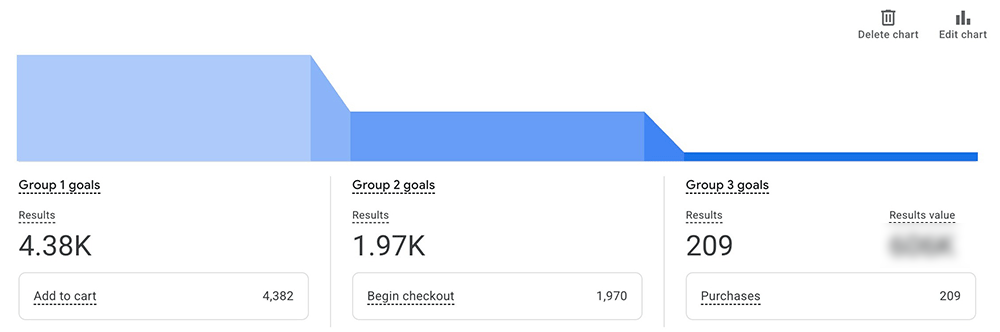
A more effective approach is to introduce layered conversion signals that reflect different stages of intent. This typically includes actions such as clicks to the booking engine, room selection or add-to-cart behaviour, checkout initiation and the final booking value itself. Assigning relative values to these interactions allows PMAX to interpret progression rather than just completion.
The goal is not to replace booking value as the primary signal, but to give the system more context around how intent develops. This has two effects.
First, it increases the volume of usable data, particularly in accounts where booking volume alone is not sufficient to drive stable learning. Second, it allows PMAX to explore and optimise beyond users who are already at the point of conversion.
This does not eliminate brand influence, nor should it. Brand demand remains a core component of hotel performance. However, it reduces the likelihood that the system will over-concentrate on the narrowest segment of high-intent traffic.
Signal design does not solve every limitation of PMAX, but it fundamentally changes how the system behaves. And in most cases, this is the difference between a campaign that confirms existing demand and one that can begin to expand beyond it.
PMAX Is No Longer a Black Box
One of the most persistent criticisms of PMAX has been opacity. The system makes decisions, but you cannot fully see why. That criticism was more valid in the initial years of PMAX than it is today.
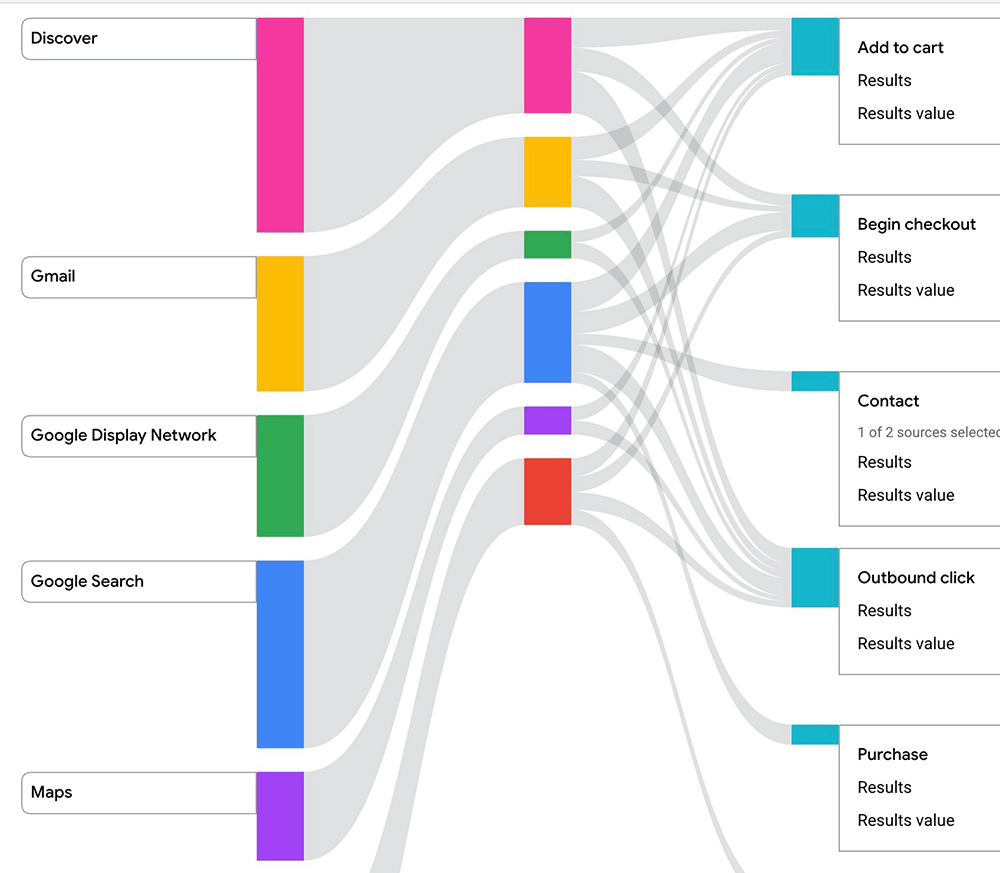
Since early 2025 Google has progressively expanded PMAX reporting. Search term data is now accessible within campaigns, asset group performance is visible, and channel mix breakdowns show how budget is distributed across Search, Display, YouTube, Gmail, Discover and Maps. For hotel accounts, this is meaningful. If a partner or agency claims PMAX is “basically all brand,” that is now a testable statement rather than an assumption.
Search term reporting shows which queries the campaign is capturing. Channel mix data indicates how spend is allocated across surfaces. In the accounts we manage, placements such as Gmail appear consistently, a surface that sits well outside traditional branded intent and is rarely acknowledged in the “PMAX is only brand” narrative.
That said, transparency still has limits. In a typical hotel campaign, a PMAX setup generating 20,000 impressions may surface only a portion of those in the search terms report, and only a portion of the complete search terms are available for analysis. The remainder is distributed across placements that are not yet fully broken out. Certain inventory, including hotel-specific meta search placements, are not currently available in a full campaign-level isolation within PMAX reporting.
The picture is therefore still partial, but materially more complete than it was. What that partial visibility tends to show in well-structured hotel accounts is a distribution of activity across surfaces, with non-brand and discovery placements contributing alongside branded demand. In poorly structured accounts, brand concentration can still dominate, but it is now visible and therefore addressable. The black box argument has not disappeared, but the claim that PMAX cannot be analysed is increasingly difficult to sustain.
Transparency does not guarantee performance. It does mean that performance can be diagnosed.
New Hotels, Data Constraints and Why There Is No Universal Answer
PMAX thrives on data.
New hotels launching without historical conversion signals face a genuine challenge. With no booking history, limited brand demand and high non-brand CPCs, optimisation becomes more volatile from the outset.
However, Search-only strategies in competitive markets are not inherently safer. In many city destinations and high-demand leisure markets, non-brand Search is expensive and heavily saturated with OTA competition. A €50 per day budget can be exhausted quickly without generating enough data to produce stable learning.
For new properties, the decision is not about whether PMAX is perfect. It is about which structure can generate usable data most efficiently within the constraints of budget and competition.
In some cases, a consolidated PMAX setup can accelerate learning by aggregating signals across multiple surfaces. In others, more controlled structures may be required, particularly where demand is highly segmented or where certain markets dominate.
There is no universal answer.
City hotels with year-round demand behave differently from seasonal island resorts. Boutique properties with higher ADR behave differently from large multi-room operations competing on volume. Primary markets such as London, New York or Barcelona operate under different competitive pressures compared to secondary destinations. Any recommendation that ignores these variables is incomplete.
Budget Physics Most Agencies Avoid Discussing
Budget does not change how PMAX works, but it fundamentally changes what is realistically possible.
This is where much of the advice around campaign structure breaks down. Many recommendations assume a level of budget that most independent hotels simply do not have. At very low spend levels, up to €50 per day, the idea of running a fully segmented structure quickly becomes impractical. Splitting budget across branded Search, non-branded Search, remarketing and upper-funnel activity may sound strategically correct, but in reality it creates multiple underfunded campaigns, each lacking the volume required to learn or perform consistently.
In this environment, consolidation is not a shortcut. It is a necessity.
A single PMAX campaign allows the system to operate across multiple surfaces, aggregate signals into one optimisation model and avoid spreading limited budget across competing structures. It also reduces the need to artificially separate demand types when there is not enough data to support that separation in a meaningful way.
As budgets increase, the equation changes, but not as quickly as many assume. At around €200 per day, most hotels in competitive markets are still constrained. Non-brand Search remains expensive, OTA competition is aggressive, and segmentation still needs to be applied carefully. While additional structure becomes possible, it does not automatically lead to better performance if each component remains underfunded.
It is only at higher spend levels, often €500 per day and above depending on the market, that more fully segmented approaches begin to stabilise. This is where separating brand and non-brand activity, layering Search alongside PMAX, and introducing more controlled campaign structures becomes consistently viable.
Even then, context matters.
City hotels with year-round demand, seasonal resorts with compressed booking windows, and boutique properties with higher ADR all behave differently. The competitive pressure in high demand capital cities or high density island locations is not comparable to secondary destinations. Budget requirements scale accordingly.
Across all of these scenarios, one structural reality remains constant. Independent hotels are not competing on equal terms. OTAs operate with significantly larger budgets, broader data sets and the ability to absorb inefficiencies at scale. This distorts auction dynamics and raises the threshold for what “sufficient budget” actually means.
Against that backdrop, the idea of a single “correct” campaign structure becomes difficult to defend. At lower budgets, consolidation often outperforms fragmentation. As budget and data increase, structure becomes more important. The transition point between the two is not fixed, and it varies by property, market and competitive intensity. What matters is not following a predefined model. It is aligning structure with the level of budget and data available.
Structural Models That Exist in the Real World
There is no single “PMAX strategy.” In practice, there are multiple viable structures, each shaped by budget, data availability and how much segmentation a hotel can realistically support.
At the simplest end of the spectrum is a single blended PMAX campaign. This model runs one campaign across all surfaces and intent layers, allowing the system to optimise freely based on the signals it receives. It is simple and efficient, particularly at lower budgets where fragmentation would weaken performance. However, without exclusions or segmentation, this structure can over-represent brand in reporting. That does not make it inherently flawed, but it does require careful evaluation of what the campaign is actually capturing.
A more controlled variation is a dual PMAX structure, where brand and non-brand demand are separated. One campaign captures brand intent, while a second campaign excludes brand terms and often remarketing audiences. This allows for clearer performance evaluation, with separate ROAS expectations for each demand type, while still retaining the benefits of automation across surfaces. It also introduces a degree of intent isolation without starving the system of data. For many constrained budgets, this structure represents a practical balance between control and efficiency.
Some hotels prefer to keep brand activity fully visible within Search. In this model, a dedicated branded Search campaign runs independently, while PMAX focuses more on expansion and feed-driven placements. This hybrid approach provides greater transparency for brand performance while still leveraging PMAX as a multi-surface system. It is often as much a reporting and control decision as it is a performance one.
At the more advanced end, fully layered architectures combine multiple campaign types and segments. These typically include branded and non-branded Search, standalone Hotel Ads where available, PMAX, and upper-funnel formats such as YouTube or Discovery, often split further by core geographic markets. Structurally, this is the most complete approach. It allows for detailed control, segmentation and testing across demand types. It is also budget intensive and, for many independent hotels, not realistically sustainable.
The key point is not which model is “best.” It is that these structures are not directly comparable in isolation. Performance outcomes are shaped by how each model aligns with budget, data and market conditions. Drawing universal conclusions about PMAX without accounting for structure leads to misleading results.
| Daily Budget | What It Usually Means in Practice | Most Realistic PMAX Structure | Main Limitation |
|---|---|---|---|
| Up to €50/day | Severely budget-constrained for almost any hotel in a competitive market. Splitting into multiple campaign types usually creates underfunded structures. | Single PMAX campaign, often used as a consolidation layer across surfaces. | Not enough budget to sustain meaningful separation between brand, non-brand, remarketing and upper funnel activity. |
| Around €200/day | Still constrained for many hotels, especially in high-demand city or leisure markets. More structure becomes possible, but not without trade-offs. | Single PMAX with tighter controls, or a more selective hybrid structure depending on market and data quality. | Additional segmentation may still leave each campaign underfunded, particularly in non-brand environments with strong OTA competition. |
| €500/day and above | More stable territory for segmented campaign structures, although requirements vary significantly by market, season and property type. | Layered approach with stronger segmentation, potentially including brand/non-brand separation, Search alongside PMAX, and more controlled structures. | Even at this level, scale requirements rise quickly in major destinations and competitive markets. |
So, Is PMAX “Only Brand”?
It can appear that way under certain structures. It can underperform when signal design is shallow, and it can struggle when data is limited or inconsistent.
But the blanket statement that PMAX is “basically all brand” ignores how the system actually works, how travel inventory has evolved, and how budget realities shape performance architecture.
In hospitality, there is no universal media blueprint. There is only structured decision-making based on data maturity, competitive pressure, market segmentation, budget scale and how intelligently automation is implemented.
PMAX is not inherently brand-driven. It is driven by structure, signal depth and capital allocation.
For some hotels, it should be layered. For others, it can run alone effectively. For most, the correct answer sits somewhere in between. What matters is not whether you run PMAX. What matters is whether you understand how to build it properly.
If you are questioning whether PMAX is right for your property, the answer will not be found in a LinkedIn debate. It will be found in your data, your market and your realistic budget.That is a conversation we have with every hotel we work with.
At Kollective, we work exclusively with boutique hotels and resorts. We build around your data, your market and your budget – not retail templates, generic playbooks, or blanket statements dressed as strategy.