


Choosing the Best SEO Keywords for Hotels
Hotels do not compete in a neutral search landscape. They operate inside an ecosystem shaped by OTAs, Google’s own hotel modules, paid placements, and brand demand asymmetry. Choosing keywords without acknowledging that structure is not strategy. It is guesswork.
Much of the advice available online today is either outdated, overly generic, or written to satisfy an algorithm rather than a hotel’s revenue model. There is no shortage of content about the best SEO tactics for hotels. There is, however, a shortage of clarity.
Since 2011, we have worked exclusively in hospitality marketing, supporting independent boutique hotels, seasonal island resorts navigating compressed demand windows, and high-ADR properties where positioning and direct demand matter more than volume. We have seen what works, what fails, and a long list of tactics that sounded convincing but never translated into bookings. That experience has shaped a set of opinions that are practical, occasionally contrarian, and grounded in what actually drives measurable results.
Search behaviour, search results and competition have fundamentally changed in recent years. Independent hotels are no longer competing only with neighbouring properties. They are competing with global platforms, paid placements, hotel price modules, map packs and increasingly AI-driven summaries that influence brand perception before a user ever clicks through to your website.
SEO is not dead. It is simply less forgiving.
For most independent hotels, choosing the right SEO keywords is not about chasing the biggest headline phrases in your destination. It is about identifying realistic, defensible opportunities that reflect your true positioning and attract guests who are likely to book. This guide lays out a commercially grounded framework for hotel keyword research based on what works in competitive markets.
SEO Reality Checks for Hotels
Before you build your keyword list, you need to be honest about what you are competing against.
Every hotel owner would love to rank first for a phrase like “best hotel in [destination]”. The visibility feels powerful, the search volume looks attractive, and it appears to represent market dominance. In most established destinations, it is also the fastest way to waste months of effort.
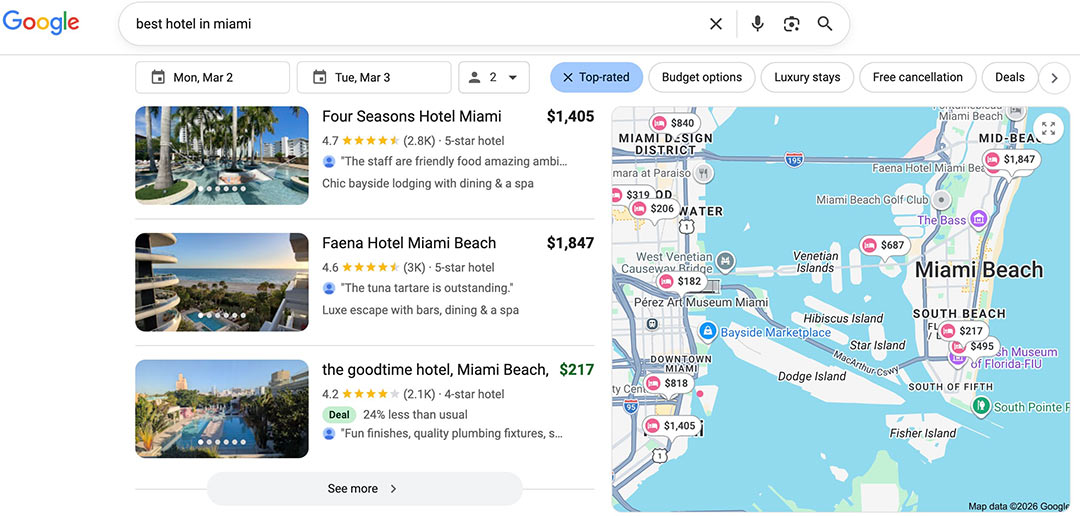
Broad destination terms are not just competitive. They are dominated by paid placements, Google-owned hotel features, and large aggregation platforms and OTAs. Even if you manage to rank organically, your website is often competing for attention far below the fold, and far away from any click.
Let’s apply a few reality checks.
SEO Reality Check #1: Destination Head Terms Are Structurally Dominated
Search for broad phrases such as “best hotel in Charleston” or “best resort in Aruba” and you will typically see ads, hotel price modules, map results and large comparison platforms occupying most of the visible space. Organic listings compete within a shrinking window of attention.
In destinations with deep supply or global demand, the probability of a single independent hotel ranking sustainably for these head terms is extremely low – and even if you do appear, you are positioned inside a comparison-driven environment designed to encourage browsing, not direct booking.
This is not a question of effort. It is a question of structure.
If your hotel operates in a smaller regional location with limited competition, the dynamics may differ. But in major tourism markets, broad destination terms rarely provide a durable advantage for independent properties.
SEO Reality Check #2: OTAs Compete at Scale You Cannot Match
Online Travel Agencies operate at global scale. They control millions of indexed pages across destinations, maintain vast backlink profiles built over years, and benefit from entrenched brand behaviour and high direct traffic. Their authority is reinforced by deep integration within Google’s commercial ecosystem.
They are built to rank for comparison and superlative queries at scale. Independent hotels are not.
Competing directly for phrases like “best hotel in Athens” or “top resorts in Aruba” is rarely a rational strategy unless your property already has exceptional national or international recognition. Even then, visibility is often filtered through editorial listicles or aggregator rankings rather than your own website.
SEO Reality Check #3: High Volume Is Often Low Value
There is a psychological trap in hotel SEO. The highest volume keywords appear to be the most important, which makes them emotionally difficult to ignore.
In reality, high volume usually signals high competition and diluted intent. That combination lowers realistic ranking probability and reduces expected return.
Hotel SEO is not about theoretical visibility. It is about bookings. The objective is not to rank for the biggest phrase in your market. It is to capture the most valuable demand you can realistically win.
A Better Strategic Question
Instead of asking, “How do we rank for the biggest term in our market?” ask, “Where does our property have a specific, defensible advantage that platforms cannot easily replicate?”
That shift in thinking is the foundation of effective hotel keyword research. Recognising structural realities is not pessimism. It is a strategic discipline. The goal is not to compete everywhere. It is to compete where you have an advantage.
Most high-volume, non-branded hotel queries do not exist in a neutral organic environment. Searches such as “hotels near me,” broad “[City] hotel” terms, and even mid-volume amenity + city combinations will trigger map packs, hotel pricing modules and comparison-driven interfaces before traditional organic listings are visible. In these environments, visibility is shaped heavily by aggregation platforms and paid placements.
For most independent hotels, building an organic SEO strategy around these queries is structurally inefficient. Even if organic rankings are achieved, they will sit below dominant interface elements and deliver limited commercial impact. These keywords are not inherently wrong, but they are rarely strong candidates for organic-first investment. In most cases, they are more effectively addressed through paid search or hotel advertising strategies rather than long-cycle SEO effort.
Disciplined hotel keyword research therefore begins with exclusion as much as inclusion. SEO resources are finite. Choosing where not to compete is part of the strategy.
For most independent properties, this means concentrating on four core categories of keywords that reflect how real guests search and how bookings actually happen.
The Four Core Keyword Categories for Hotels
For most independent properties, disciplined hotel keyword research should concentrate on four core areas:
- Branded keywords
- Location-related keywords
- Amenity-driven keywords
- Experience-driven keywords
These categories are not new. What has changed is the competitive environment around them and the level of precision required to compete effectively.
1. Branded Keywords
Branded searches include your hotel name, with or without variations and represent how online users interpret or describe your property when searching for it.
Examples:
- [Hotel Name]
- [Hotel Name] Resort
- [Hotel Name] Beach Hotel
- [Hotel Name] Boutique Hotel
- [Hotel Name] Villas
- [Hotel Name] [destination]
- [Hotel Name] Adults Only Resort
- [Hotel Name] Luxury Suites
Most hotels assume they automatically rank first for their own brand. This is not always true.
In many cases, the issue is not only ranking for your exact registered name. It is understanding how guests actually search for you. If your property is officially positioned one way, but OTAs, review platforms or past marketing materials have described it differently, search demand may still reflect those alternative descriptors. We have seen properties refine their branding while search behaviour continued to favour previous terminology, creating measurable friction in direct bookings.
You may find meaningful search volume across multiple variations. If your website only optimises around one rigid version of your brand name, you risk losing visibility for how real users actually search. Brand clarity and naming consistency across platforms will directly influence branded search performance.
Branded informational searches are also important:
- [Hotel Name] rooms
- [Hotel Name] menu
- [Hotel Name] spa
- [Hotel Name] wedding
- [Hotel Name] parking
These are high-intent searches by users already familiar with your property.
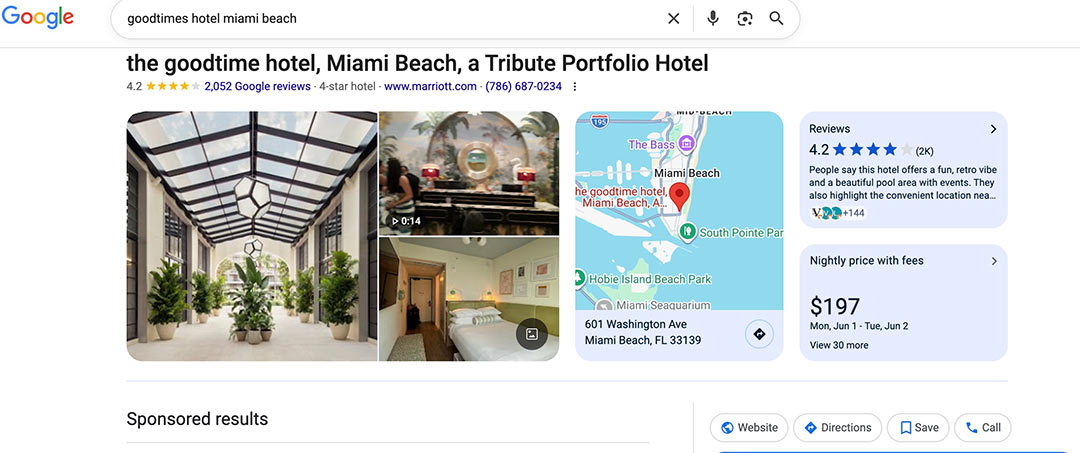
When branded search is not properly managed, the usual outcome is OTA listings outranking your official website. If you do not clearly define and structure your brand online, third-party platforms will step into that space. Owning your branded search results is the first and most controllable step in any hotel SEO strategy.
For newly launched hotels without established brand search volume, branded SEO is less about volume capture and more about clarity and consistency. In these cases, location and positioning keywords carry greater strategic weight in the early stages.
Location-Related Keywords
We have already established that broad phrases such as “hotel in Aspen” or “hotel in Santorini” are highly competitive. Location strategy, however, does not stop at the city or island level.
Brand + Location Searches
There is a material difference between “hotel in Aspen” and a search that includes your specific property name alongside the location. Branded location queries reinforce geographic relevance and should be reflected clearly in page titles and on-page content.
Neighbourhood and Micro-Location Keywords
In large cities, meaningful search demand often exists at the neighbourhood level rather than just the city level. While still competitive, these searches are typically more attainable than broad city terms and often carry stronger booking intent because the guest has already narrowed their focus.
The same principle applies in island or resort destinations, where demand may concentrate around specific beaches, villages or districts rather than the island name alone. These more precise location modifiers are often commercially valuable.
Hotels Near Specific Attractions
Keywords structured around “hotel near [specific attraction]” can be strategically effective in both major destinations and smaller markets. A reality check still applies: targeting a landmark you are not genuinely close to will not convert, even if it ranks. However, with informed local knowledge, most hotels can identify attractions or venues where competition is lower and intent is higher.
Examples include:
- Smaller or niche museums
- Local landmarks or cultural sites
- Live music or sports venues
- Hospitals, universities or theatres
- Ports, marinas or event centres
These searches may generate lower volume, but the user intent is often highly logistical and therefore commercially strong.
Competing effectively in this space typically requires dedicated content addressing proximity, context and relevance. This is one of the clearest practical cases for maintaining a well-structured location content section on your website.
3. Amenity-Driven Keywords
Amenity-driven keywords combine a specific differentiator with location context.
However, not all amenity searches are strategically equal.
Short, generic modifiers such as:
- “hotel in Key West with free parking”
- “pet-friendly hotel in Aspen”
- “hotel in Charleston with pool”
- “beachfront hotel in Mallorca”
- “spa hotel in St. Lucia”
will typically trigger map packs and hotel comparison modules. In these environments, organic listings sit beneath interface layers designed for filtering and aggregation. These searches may carry strong intent, but they are rarely organic-first opportunities for independent hotels.
More defensible amenity-driven searches combine specificity with positioning:
- “adults-only boutique hotel in St. Lucia”
- “ski-in ski-out hotel in Aspen”
- “historic manor hotel in the Cotswolds”
- “design-led boutique hotel on the Amalfi Coast”
- “cliffside hotel in Santorini with caldera views”
These phrases narrow intent, reflect identity and reduce direct comparison pressure. They allow independent properties to compete on differentiation rather than scale.
Simply listing facilities is not enough. The amenity must be distinctive, authentic and supported by structured, context-rich content on your website.
Generic descriptors such as “luxury hotel” or “boutique hotel” are heavily saturated and rarely create strategic advantage on their own. Specificity performs better. The narrower and more genuine the differentiator, the more defensible the keyword becomes.
4. Experience-Driven Keywords
Experience-driven keywords reflect the type of stay a guest is actively seeking, not just the physical features of your property.
These often revolve around positioning language such as: romantic, adults-only, historic, design-led, family-friendly, quiet, party-focused, wellness-oriented.
Behind these terms is purpose. A honeymoon. A weekend escape. A cultural trip. A festival stay. Experience-driven searches frequently overlap with location and amenity modifiers, which is where strategic opportunity tends to emerge.
The key variable is honesty.
If every hotel in your city calls itself “boutique,” the word loses strategic value. Optimising for an identity that does not genuinely reflect your property creates friction rather than conversions.
Even “budget-friendly” or “no-frills” are positioning statements. If that is your market, own it. Precision converts better than aspiration.
Search Volume vs Conversion Probability
Search volume measures demand. It does not measure commercial value.
A broad phrase like “hotel in Napa Valley” may generate significant traffic, but it attracts a wide mix of browsing behaviour. A more specific query such as “hotel in Napa Valley with on-site winery and tastings” may attract fewer searches, yet represent far stronger booking intent.
For independent hotels, the strongest opportunities often sit in the middle: terms specific enough to signal clear booking intent, yet broad enough to generate consistent demand.
When evaluating keywords, consider search demand alongside the likelihood that the searcher is ready to book. Traffic alone is not a strategy. In hotel SEO, conversion probability matters more than raw volume.
How AI Is Influencing Hotel Keyword Strategy
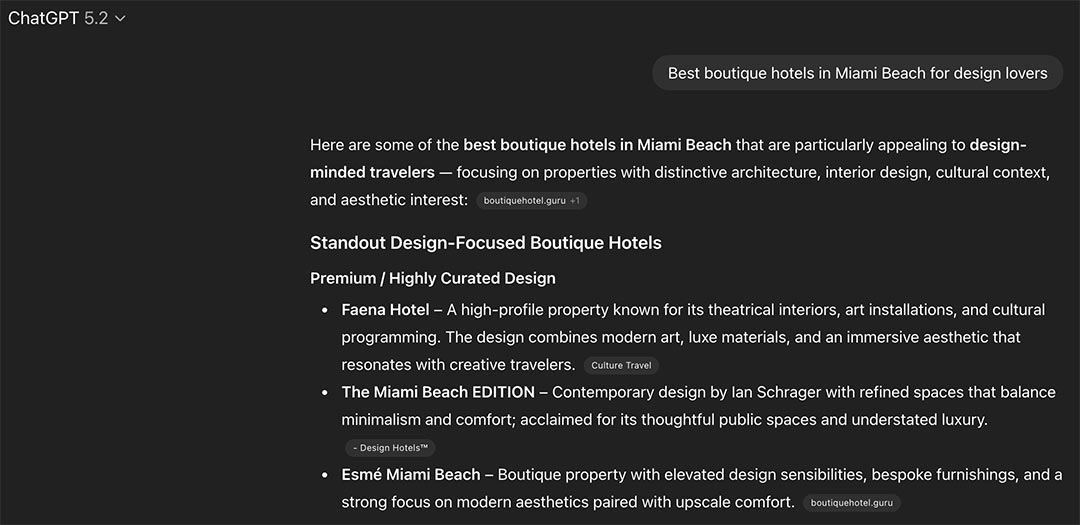
AI-driven search interfaces are now part of how travellers research accommodation. Google’s AI Overviews and tools such as ChatGPT increasingly respond to queries like “best romantic hotels in the Caribbean” or “where to stay in Nashville for a couples trip” with synthesised recommendations rather than simple lists of links.
This does not eliminate traditional SEO, but it changes the visibility layer.
AI systems tend to summarise patterns. They surface properties that are clearly positioned, consistently described and contextually aligned with specific themes. Vague positioning or inconsistent messaging makes interpretation harder.
For hotels, this reinforces an existing principle rather than replacing it: clarity wins.
A property that clearly defines its audience, amenities, location context and differentiators is easier for both search engines and AI systems to interpret. Keyword strategy therefore becomes less about chasing broad headline phrases and more about defining what your hotel actually represents in the market.
We explore the structural implications of AI-driven search for hotels in our dedicated guide on AI prompts for hotels.
Build Your Keyword List – Then Pressure-Test It
By this stage, your keyword list should include:
- Branded variations
- Location and micro-location terms
- Amenity-driven phrases
- Experience-led positioning
More importantly, it should reflect strategic discipline.
If your list is dominated by broad, high-volume destination terms, revisit it. If it aligns with your genuine positioning, your competitive realities and the type of guests you actually want to attract, you are moving in the right direction.
Keyword research is not a theoretical exercise. It is a commercial filter. The strength of your list will determine the direction of your content, your technical optimisation and ultimately your direct booking performance.
How Many Keywords – and What Tools?
There is no fixed number. For most boutique or independent hotels, starting with 10–20 strategically chosen phrases is sufficient. As your content depth grows, you can expand into related clusters around attractions, events and seasonal demand.
SEO is not built on a static list. It evolves alongside your positioning and market realities. In seasonal destinations, keyword priorities often shift throughout the year. Event-driven searches, peak-season modifiers and booking window behaviour can temporarily outweigh broader positioning terms.
In terms of tools, start with what reflects real demand:
- Google Ads Keyword Planner for directional volume data
- Google Search Console for actual query impressions
- Google Trends for recent shifts in behaviour
- Your own booking engine and enquiry data for commercial insight
Tools inform the process. They do not define it. Competitive context, positioning clarity and commercial intent matter more than any keyword difficulty score.
Some Final (Key) Words
Keyword research is not about chasing the biggest phrases in your market. It is about clarity.
Clarity around who you are for.
Clarity around where you are positioned.
Clarity around what makes your property distinct.
In a search environment shaped by global platforms, paid placements and AI-driven summaries, independent hotels win by being specific, not by being broad.
Once the keyword strategy is defined, the real work begins: structuring content properly, aligning messaging consistently and building depth around the themes you can genuinely own.
SEO rewards discipline. It penalises vagueness.
The examples in this guide are not templates. They illustrate a way of thinking. Every destination has its own structural realities, demand patterns and competitive pressures. Effective hotel SEO aligns deep local market knowledge with specialised hospitality search expertise to build strategies that compound over time.
If your current keyword strategy is built around volume rather than positioning, it is worth reassessing. And if you want a clear, commercially grounded perspective on where you stand, that is a conversation we are happy to have.