


Google Hotel Ads:
The Questions Nobody Asked Before Sign Up
Google Hotel Ads has become a default line item in hotel digital marketing budgets. Most hotels couldn’t tell you exactly when or why they started running it.
The campaign typically arrives with the booking engine contract, as part of a channel manager setup, or bundled into a digital marketing package from a platform that also manages the spend. Someone recommended it. The ROAS figures looked compelling. It was switched on.
What rarely came with that recommendation was a clear explanation of what the campaign was actually covering, what conditions needed to be true for those returns to be genuinely incremental, or whether any of that spend was duplicating activity already running elsewhere in the Google ecosystem.
The platforms making these recommendations are built to activate and manage these campaigns – that’s their product, that’s how they’re structured, and that’s what they’ll propose.
Whether it’s the right decision for a specific hotel at a specific budget, under specific conditions, isn’t really a question their model is designed to answer.
What You Are Actually Buying
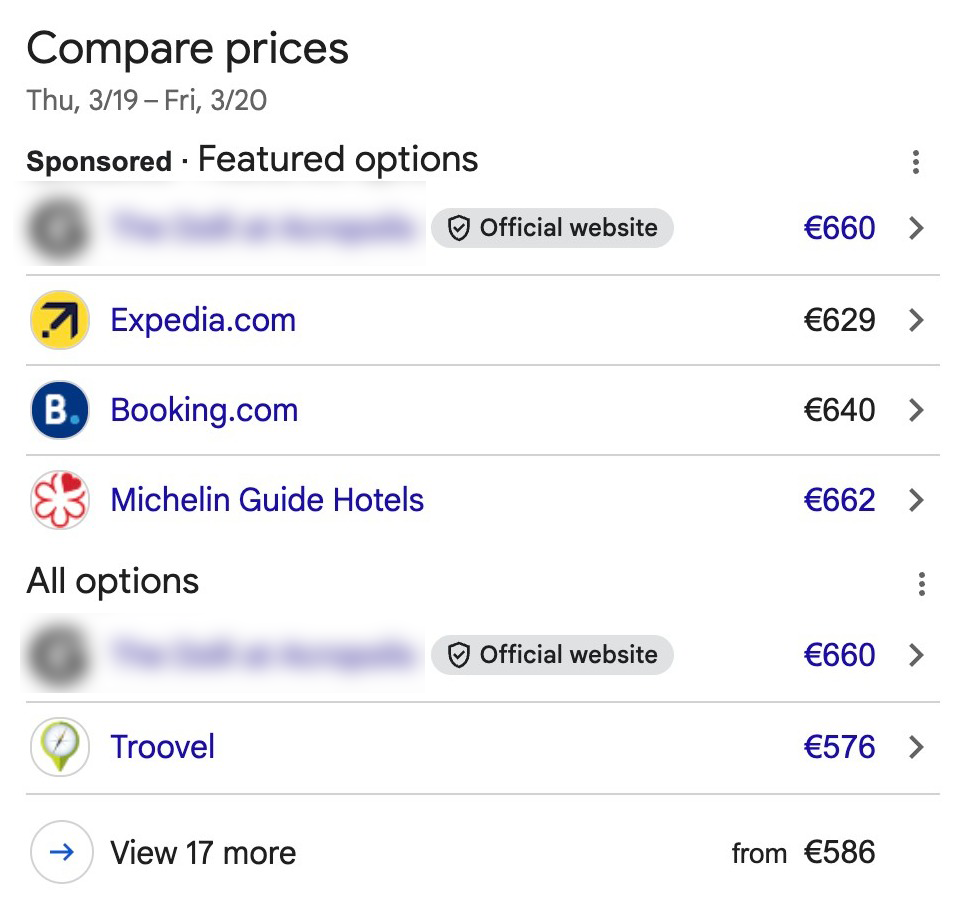
Google Hotel Ads metasearch effectively does one thing: it places a promoted listing for your hotel on searches where someone has already typed your hotel name, or a close variation of it. The guest is already looking for you. They already know you exist. The campaign gives you a second appearance in that moment, a paid promoted placement sitting alongside a free booking link that, in most cases, is already there.
That is the product. It is a direct booking, branded visibility play. It is also, clearly, a price comparison play. The guest can see your direct rate alongside OTA rates in the same interface, at the same moment. You are not just paying to appear. You are paying to compete on price in a format specifically designed to make that comparison easy.
Google Hotel Ads does not create demand. It monetises the moment a guest is already comparing you.
The question that follows is straightforward: if a guest is already searching for your hotel, and a free booking link already exists, what exactly does the promoted placement add, and under what conditions does it actually win?
The Conditions That Make HA Worth Paying For
Entering a price comparison environment with a paid placement is only rational if you are confident you can win that comparison. For most independent hotels, that confidence is rarely tested before the campaign goes live.
The first condition is rate parity, and it is worth being precise about what that means in practice. Some revenue managers enforce exact parity between direct and OTA rates. Others maintain a nominal direct advantage, keeping the direct rate a small amount below OTA pricing to give the comparison interface a clear answer. The second approach is more compelling for direct conversion.
What complicates it further is that clean rate parity, or even a direct rate advantage, does not guarantee a favourable comparison. OTAs carry structural advantages that independent hotels cannot easily replicate: loyalty and Genius-style discount programmes, reseller margin absorption that can push visible OTA rates below what the hotel itself can offer, and cancellation policies that are often more flexible and more trusted by first-time bookers. A guest looking at the same headline rate from two sources is not making a purely price-driven decision. The comparison environment is designed to look simple. It is not.
If your direct rate is higher than the OTA rate in the interface, the promoted placement is working against you. The guest can see both prices simultaneously. You have paid to highlight the fact that booking direct costs more. This is not a theoretical edge case. For many independent hotels it is closer to the norm, particularly where dynamic pricing creates unintended gaps or where the booking engine and channel manager are not synchronised tightly enough.
The second condition is visible direct booking value beyond rate. If the rates are equal but the offer is not demonstrably better, the comparison is at best neutral. A visible direct benefit, whether a rate advantage, an included element, or a genuinely flexible policy, is what turns the placement into a conversion argument rather than just an appearance.
The third condition is clean price display. This is particularly relevant for US properties, where the way Google surfaces taxes and fees in the comparison interface can make a direct rate appear higher than an OTA rate even when the underlying economics are equivalent or better. Hotels in affected markets may be paying for a promoted placement that is structurally undermined by the display format before a guest has read a single word of the listing.
None of these conditions are difficult to evaluate. Most hotels running promoted placements have never checked them.
What May Already Be Running
Before evaluating whether a dedicated Google Hotel Ads campaign is earning its place, it is worth establishing what is already running in the same ecosystem.
Performance Max campaigns for travel goals has evolved substantially since its inception and now participates in the Google Hotel Ads environment. Most hotels can now pull their rates and connect to their property without requiring a separate Hotel Center setup. The access barrier that previously limited this has largely gone. What remains is a technical dependency on the booking engine and channel manager delivering rates in a format Google can actually read. Not all systems do this reliably, which needs confirmation before assuming the integration is clean.
Where the feed is working correctly, PMAX will already have a presence in the metasearch interface. A hotel running both PMAX and a dedicated GHA campaign is not running two complementary channels. In most cases, this is duplication, not diversification.
The ROAS on the dedicated GHA campaign is typically modest in absolute revenue terms. PMAX, with stronger signal design and more sophisticated bidding optimisation, will generally outperform it on the same demand. Keeping them separate does not add performance. It fragments it, pushing the reported ROAS of each down in favour of the other, while obscuring what is actually driving the results.
We have covered the PMAX architecture for hotels in detail separately. The point here is narrower: the metasearch landscape a dedicated GHA campaign is entering may already be occupied by your own activity, and the campaigns you already have are probably better equipped to compete in it.
When HA Do and Don’t Make Sense
The argument we are making is not that Google Hotel Ads metasearch is always wrong. It is that the decision to run it is rarely made with the information required to make it correctly.
There are situations where a dedicated GHA campaign earns its place. A property with genuine rate parity enforced cleanly across all channels, a visible and compelling direct booking benefit, a booking engine and channel manager that feed rates accurately, and a PMAX setup that has been audited for metasearch participation. In that context, a dedicated GHA campaign can add a marginal but real conversion addition at the bottom of a funnel that is already working well.
Typical examples could include higher ADR properties where the absolute revenue per booking easily covers any additional cost or higher volume city hotels or larger resorts where the overall number of bookings can do the same thing. Both cases can justify the additional cost and management overhead and the economics can make sense.
There is a further scenario worth acknowledging. Most independent hotels do not run globally targeted PMAX campaigns. The budget requirements are too high and the signal quality outside core markets is too thin to justify it. Where PMAX is focused on a defined set of source markets, a dedicated GHA campaign could in theory cover geographic demand that PMAX is not reaching and provide incremental value. In practice, the ability to exclude already-targeted markets from a GHA campaign depends heavily on which platform or integrator is managing it, and most systems do not offer that level of targeting nuance. The theoretical case is cleaner than the operational reality.
But these are specific conditions. They are not the default situation most independent hotels are in when they sign up.
The more common situation is a hotel where rate parity has never been rigorously audited, where the direct booking offer is broadly equivalent to the OTA offer, where nobody has checked what PMAX is already doing in the metasearch interface, and where the campaign was activated because a platform recommended it and the reported ROAS looked reasonable.
In this situation the dedicated GHA campaign is not performing badly. It is just not doing what most hotels assume it is doing. It is reinforcing a position that is largely already covered, in a price comparison environment the hotel may not be winning, reported in isolation from the activity it is most likely duplicating.
The right question is not whether to run Google Hotel Ads. It is whether the conditions that make it worthwhile are actually in place, and whether the campaign structure around it reflects how the Google ecosystem actually works rather than how it was explained at the point of initiation.
A Few Questions Worth Asking Before the Next Invoice Arrives
Google Hotel Ads is not a bad product. It is a misunderstood one. The industry narrative around it has been shaped largely by platforms with an interest in hotels activating and maintaining these campaigns, and the result is that most independent hotels are running a channel they never fully evaluated against the conditions that determine whether it is working well.
The metasearch interface is a price comparison environment. Entering it with a paid placement requires rate parity, a compelling direct offer, clean price display, and an understanding of what the rest of your Google campaign architecture is already doing in the same space. Most hotels have not verified any of these things. Some are paying to advertise a weaker offer. Others are duplicating coverage that other campaigns are already providing with better signals and more efficient spend.
None of this means the answer is to switch Hotel Ads off. It means the answer depends on your ADR, your parity discipline, your booking engine feed quality, your campaign and marketing channel structure, and your source market targeting. None of these are difficult things to evaluate.
They are just things that rarely get evaluated because the Hotel Ads campaign arrived before the questions did.